
Industrial Radiography
Concrete XRay
Iridium-192
Cobalt-60

Radiographic Testing (X-Ray) employs gamma radiation to identify embedded items within concrete slabs. This testing utilizes two distinct radioactive sources: Iridium-192 for concrete slabs measuring up to 10 inches in thickness, and Cobalt-60 for slabs ranging from 10 to 18 inches in thickness.
During Radiographic Testing, gamma radiation penetrates the concrete, and the resulting waves are captured by a CCD Detector, which generates a permanent image of any embedded items present. This image is processed in near real-time, allowing for immediate marking of any detected items directly on the concrete slab. In conjunction with the slab markings, a digital radiographic image serves as a permanent record of the tested areas, which is delivered to clients either via a USB drive or an emailed report.
Due to safety regulations and guidelines, Radiographic Testing is predominantly conducted after standard business hours. It is imperative that all floors undergoing testing are vacated of non-monitored personnel prior to the arrival of the testing team.
Before scheduling the service, a comprehensive checklist is provided to assist companies in preparing the site and reviewing all necessary safety precautions that must be addressed prior to the crew's arrival.
In scenarios where concrete cutting is required, it is essential to recognize that the concrete slab may contain hidden elements. X-Ray technology is the most effective means to accurately identify safe zones for penetration in slabs, particularly those that are post-tensioned, thus minimizing the risk of inadvertently severing critical embedded items.
In order to ensure a successful and safe service, it is essential to adhere to the following steps:
-
Consultation with Building Engineers and Management - It is vital to engage with building engineers and the building manager regarding the upcoming radiographic service.
-
Confirmation of Occupancy - We require clarity on the schedule for when all tenants and service personnel will be off the floors where penetrations are taking place, as well as those where the penetrations will exit.
-
Concrete Thickness Information - Prior to mobilization, we must have detailed information regarding the thickness of the concrete.
-
Hole Dimension and Quantity - We need to know the dimensions and amount of the penetrations to ensure adequate time is dedicated to the project.
-
Marking the Underside - Both the top and underside of the concrete must be marked before our arrival. The center point of the penetration must be marked on the top of slab and the exit point must be marked on the underside of the concrete. While some contractors may drill pilot holes, we recommend the use of a “Drill-Spotting” device to efficiently ascertain the centers of penetrations on the underside. A suitable model may be sourced from Hilti at the following link: https://www.hilti.com/c/CLS_MEA_TOOL_INSERT_7127/CLS_CONCRETE_SCANNERS_SENSORS_7127/r3538?activeTab=preconfigured-kits-tabs
Upon arrival at the site, the team will conduct a review of work areas, post appropriate signage, and set up the necessary equipment. During this process, access to all offices and suites on the relevant floors will be required to ensure that these areas are clear of the general public. Once confirmed vacant, these areas can be secured again.
Historically, this service has depended on “medical” X-ray film, which, despite its designation, is tailored for industrial applications. Two primary types of radioactive isotopes are utilized to emit a collimated gamma beam at a predetermined projection angle for a specific duration to expose the film. Concrete Imaging, Inc. has moved away from this traditional methodology due to evolving environmental considerations; as buildings are constructed in closer proximity and increasingly utilize glass facades instead of traditional materials, it has become imperative to reduce overall radiation emissions to safely conduct operations within these structures.
To adapt to these changes, CIM has invested in Digital CCD technology, which boasts an efficiency increase of approximately 90% compared to traditional film radiography. This advancement offers numerous advantages over older methodologies. Utilizing the digital system allows for immediate results to be emailed to interested parties, and for many projects, clients are provided with a USB drive containing the radiographic images.
Additionally, a summary of findings is completed and forwarded via email for review. This report is presented in PDF format and contains the original images paired with a photo of the slab layouts.
We are able to offer various types of exposure orientations to provide coverage for multiple penetration sizes.

A single exposure (illustrated above) measures 14 inches by 17 inches and is the most commonly used type of exposure. This size provides adequate coverage for holes up to 5 inches in diameter. Despite the larger dimensions, it only yields a viewable area of approximately 10 inches by 13 inches. This reduction is due to the possibility of an item being located near the edge of the image, which may cause it to be "blown off" due to the angles of deflection involved.

The next image is referred to as a long double. This type consists of two single exposures taken in the same area that are overlapped in the center to ensure that no items are missed. Long doubles are typically used in wall applications to maximize coverage within the wall. A long double measures approximately 32 inches by 14 inches, providing a viewable area of 28 inches by 10 inches. This technique is also employed for slab openings by overlapping multiple exposures along the cut line.

The subsequent image is known as a short double. Similar to long doubles, short doubles consist of two overlapping single exposures taken in the same area to prevent oversight. This type is specifically used for penetrations that exceed 5 inches in diameter but are less than 8 inches. A short double measures roughly 18 inches by 24 inches and provides a viewable area of 12 inches by 20 inches.
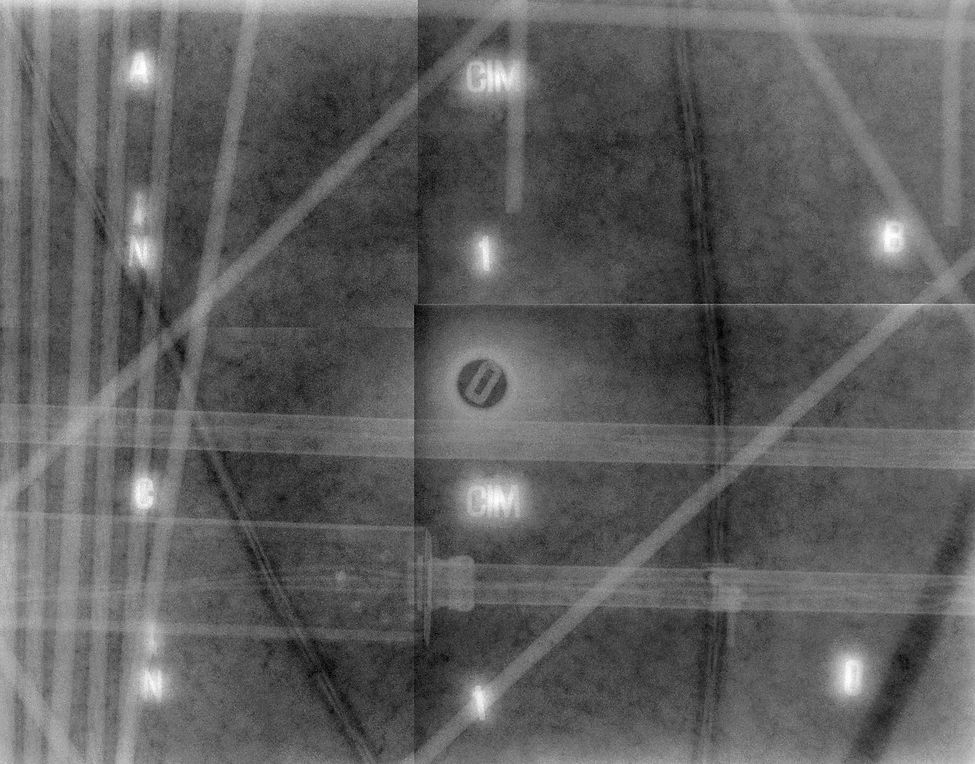
Finally, we have the quad exposure, which consists of four single exposures taken in the same area that are overlapped in the center to ensure thorough coverage. Quads are utilized for penetrations that are 8 inches but less than 17 inches in diameter. A quad measures approximately 28 inches by 20 inches and provides a viewable area of 24 inches by 18 inches.